For Product teams
Protect your roadmap. Scale your vision.
Usivity lets your users make the small changes themselves, so your team builds what matters.
Your role, redefined
Stop getting stuck with customer requests.
Your job is to set the direction of the product, the most important asset in the business.
But when your loudest customers demand one-off changes and the roadmap bends for them, you stop being a product leader and become a feature organizer. Usivity gives those customers a way to help themselves, so you can get back to building what matters.
Requests
Deflect feature requests.
Customers get a self-serve path for changes to how the product looks and shows data, before those requests become triage, scoping and sprint work.
Roadmap
Hold your roadmap.
Stop letting individual customers set your priorities. Set a direction and keep it.
Escalations
End escalations.
When customers can make the change themselves, the escalation stops before it reaches your inbox.
Engineering
Reclaim engineering time.
Put the time lost to reactive, one-off work back into the product.
The pain
The roadmap hijack.
You built a product strategy. Then a customer called. Now the sprint is on fire and the roadmap is three months behind.
Your roadmap isn’t yours
Every big account thinks it has a say. One call with a VP at a key customer and your quarter changes.
Emergency releases
When a customer threatens to churn, “not on the roadmap” stops being an option. The team drops everything.
The PM role erodes
Every hour of triage is an hour out of strategy meetings.
Escalations loop you in
A complaint becomes a ticket, the ticket a pattern, and the pattern lands in your inbox with five people copied.
Strategy slides to “later”
Firefighting wins. The roadmap review slips and the vision document stays in draft.
One-offs pile up
Each concession seems small, but each becomes a precedent. Over time the product is a patchwork.
With Usivity
Rule your roadmap. Lead with evidence.
Customers make the changes they need without feeling ignored, and your team stays on the roadmap.
Then every request shows up in your reports, including the ones your product can’t do yet. In aggregate, that is the clearest signal you have of what to build next.
- Deflect requests without saying no
- See what users actually ask to change
- Know what to build next, with proof instead of anecdotes
- Hold your roadmap and keep customer trust
Reports
Know what your customers need, from what they do.
Not clicks and page views: the changes users make, the ones they keep, and the requests your product can’t do yet, counted across every user and every account.
Then use it:
- Make a change many accounts make the default for everyone
- Bring counts and customers’ own words to roadmap reviews
- Find the gaps behind an account’s requests before renewal
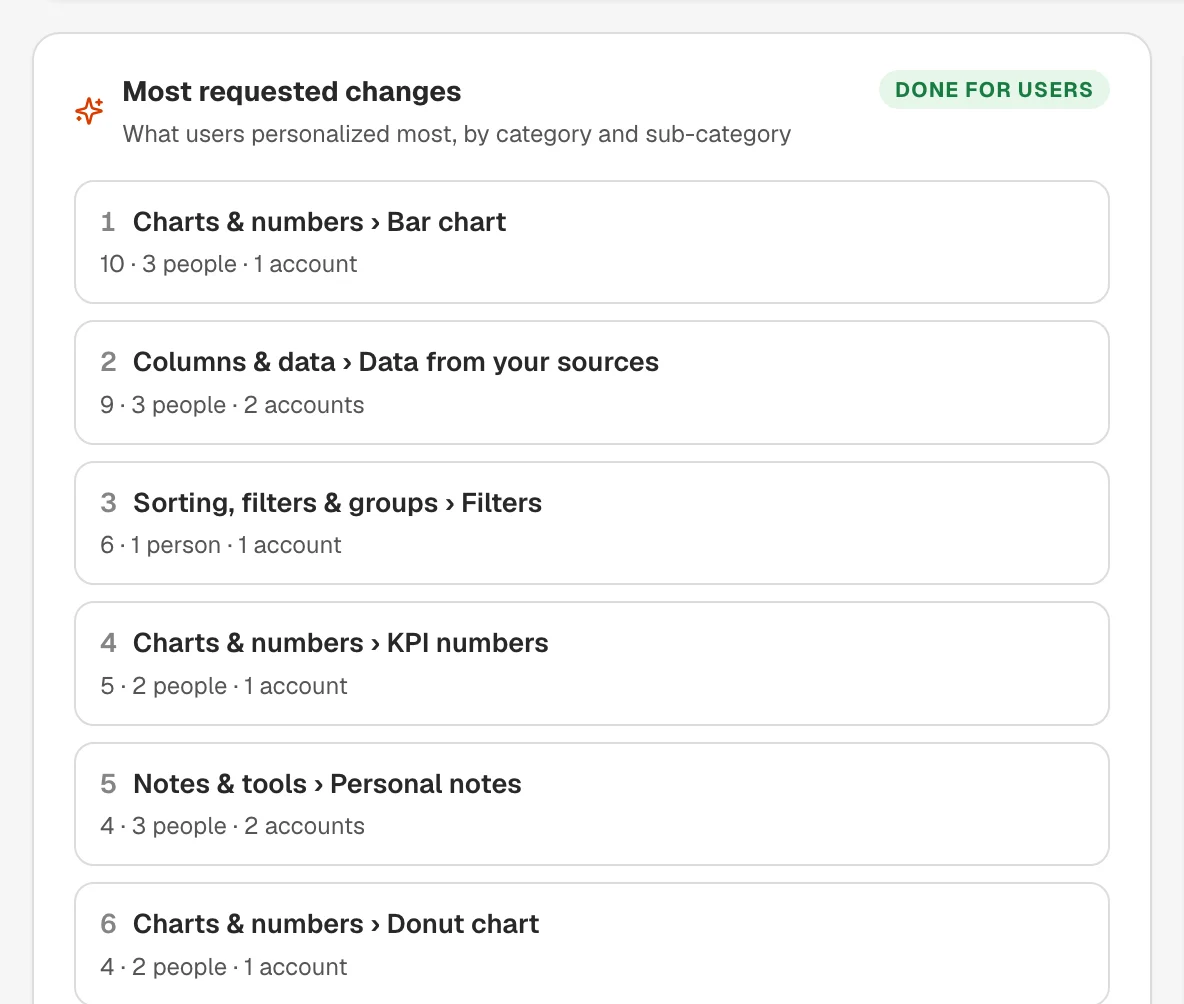
Most requested changes
What do customers change most?
Ranked by category and sub-category, with how many people and accounts made each.
Not possible yet
What did they ask for that we can’t do?
Every request the product couldn’t do, by zone, in their own words, and who asked, by account and role.
Still on after 14 days
Which changes stick?
Separate a passing idea from a lasting need before you build it for everyone.
Data users add
Which fields should we show by default?
The fields from your data sources users add to their own views.
Accounts
Which accounts make the product their own?
Users, personalizations and Personal Touches per account, and accounts to watch each week.
Spend engineering time on requests, or let customers do it?
With Usivity, customers shape their own experience by asking for it, while your engineers work on the roadmap.
Front-end engineering time

Every customer wants a different product. You no longer have to build them all.
Test an idea
Try a change with a few accounts first.
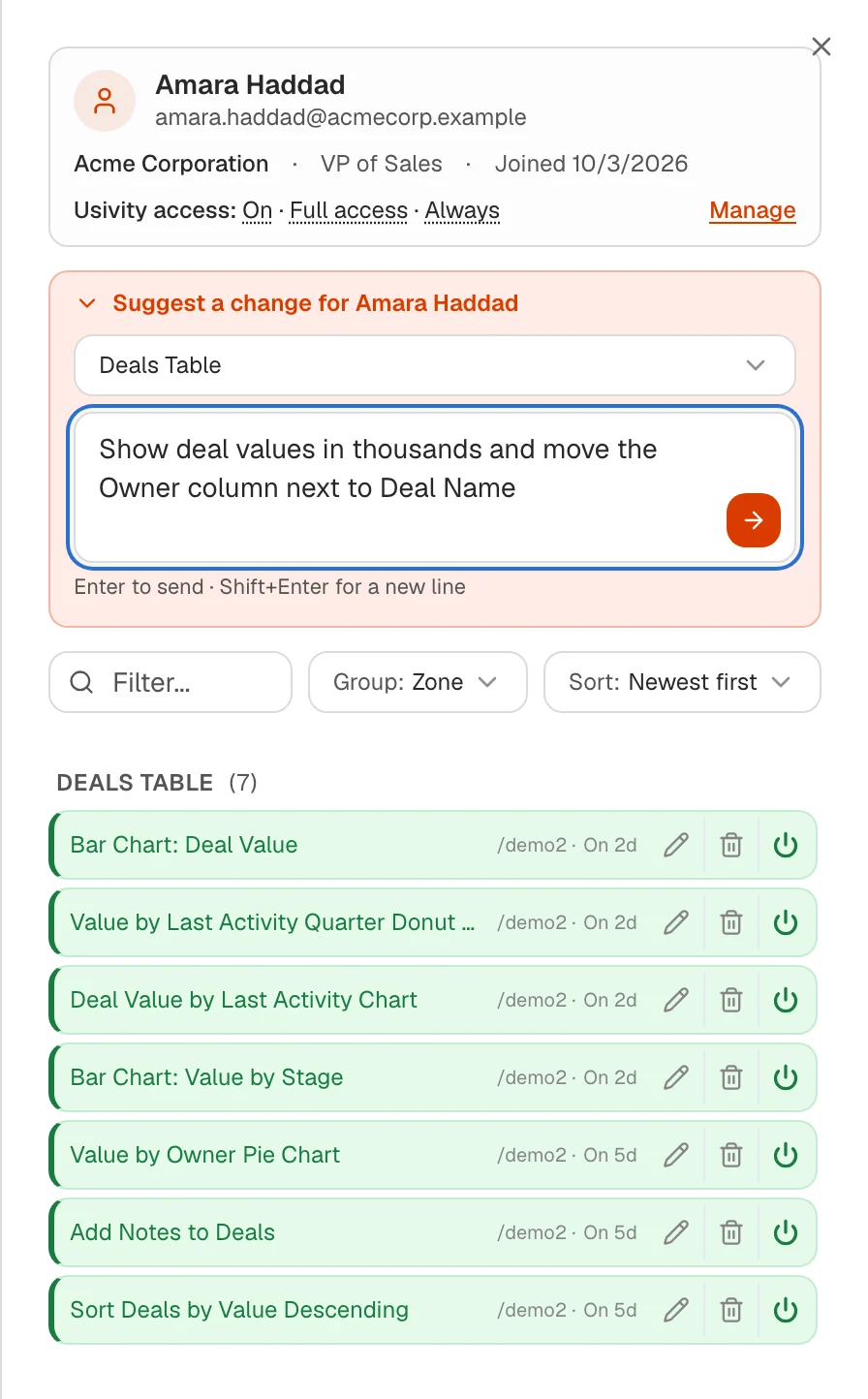
Have an idea for a better default? Before you build it, write it as a personalization in the Usivity portal and send it to the users of the accounts you want to learn from. Their views change. Your product and your code don’t.
- 1
Describe the change Pick the part of the product and write it: “Show the Value column first and total it at the bottom.”
- 2
Send it to them Find those accounts’ users by company and send it to all of them. Each user can apply it from their Usivity panel, or decline it.
- 3
See whether it sticks Reports show the changes your team sent, who applied or declined them, and who switched them off later. Build what sticks.
It isn’t a feature flag or a release. It’s a personalization on each user’s own view, and they can switch it off at any time.
The outcome
Protect the roadmap. Give users what they need.
Roadmap security
Your team stays on strategy, without “save the customer” fire drills.
Proof for what to build
Requests in aggregate show what users make for themselves, and what they wish they could.
One product that fits every account
Ship a standard product that feels made for each customer, with no custom code.
Let your users make the small changes. Your team builds what matters.
In ten minutes we’ll show you what your customers can change on their own, and what your team never has to build.
Book a 10-minute demo
We reply within one business day.
You’re booked.
We’ll reach out within one business day to confirm your 10-minute demo.